Start with Your Daily Command Center: The Dashboard
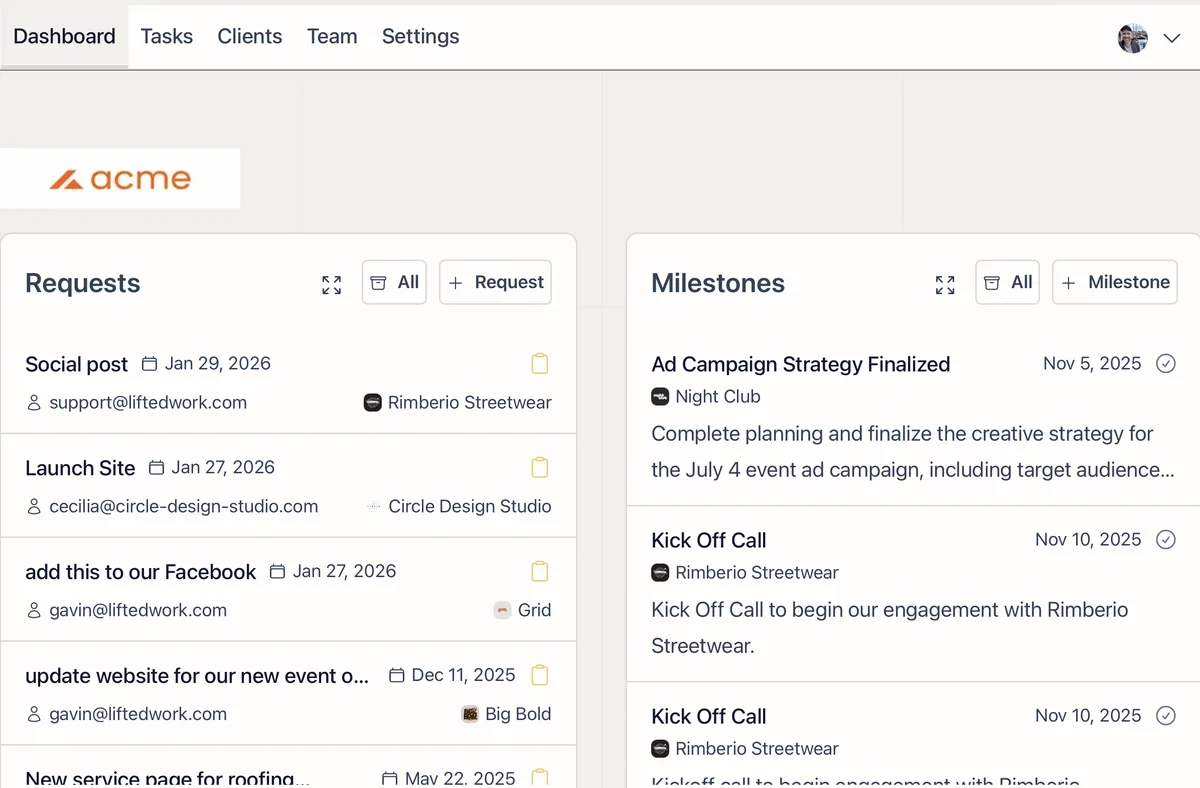
Each morning, start with a quick scan of your Dashboard. It shows you:
- Incoming client requests: new requests appear the moment a client submits them
- Upcoming milestones across all clients
- Recent correspondence: email threads with clients and team
- Monthly stats panel: won/lost clients, assigned vs. worked hours, invoices, completed tasks, upcoming tasks, and overdue tasks
You can also view individual team members to see:
-
Assigned hours per person per month
-
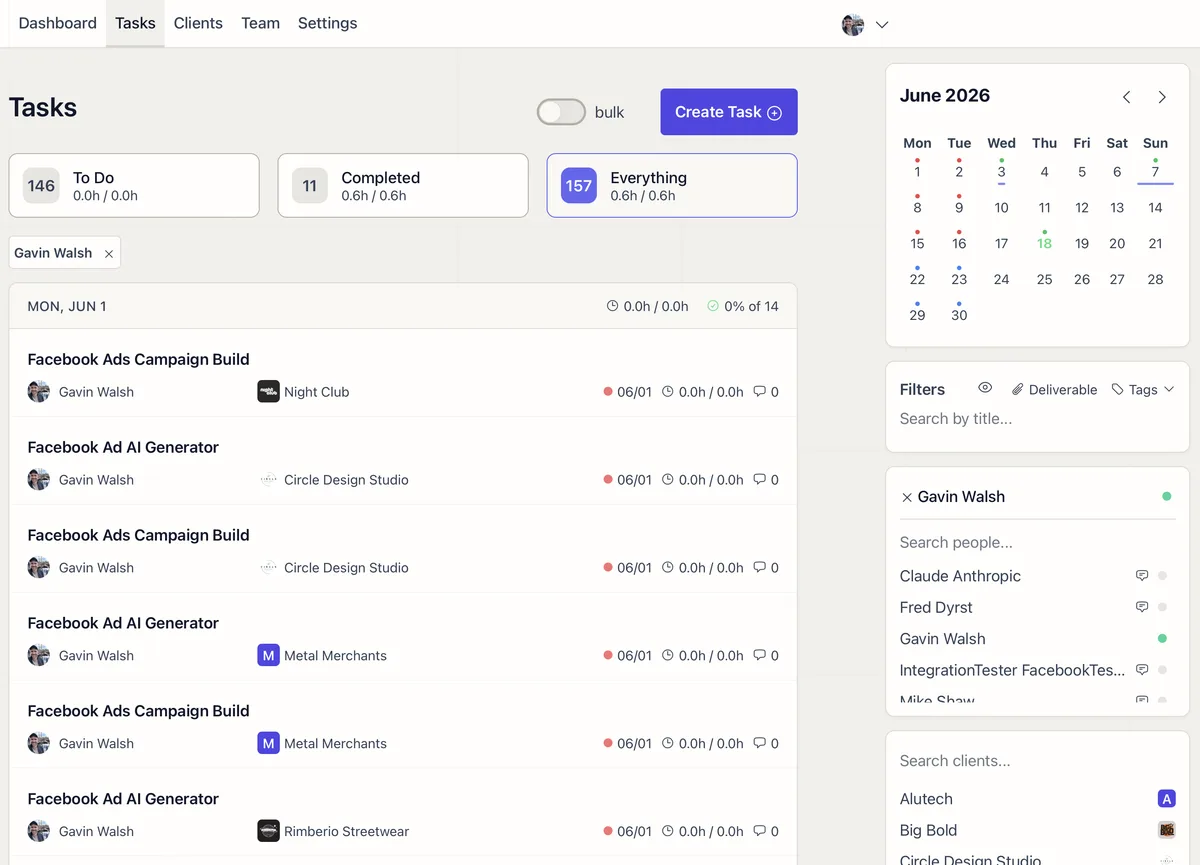
Their upcoming tasks
-
Completed work, broken down by person and client
Use this space to stay ahead of your team’s bandwidth and quickly rebalance work if needed.
Monthly Review: Hours and Task Tracking by Client
On a monthly basis, head to the Clients screen to see a time-based breakdown:
-
View hours assigned and worked per client for the current month
-
Use the Dashboard’s team member view to drill into hours by person and client
This makes end-of-month reporting straightforward. Check for over- or under-servicing and validate retainer usage against actual work delivered.
Quick Daily Scans: Client Status at a Glance
From the client list, use filters and sortable columns to:
-
Check for pending client requests
-
Review client notes
-
Monitor custom statuses (like ad budgets or campaign stage)
-
Sort by upcoming work, hours, or custom metrics
You can also add custom status columns (like monthly ad spend or blog post count) and sort by them to stay organized across multiple services and retainers.
Deep-Dive into a Client’s Tabs
Every client opens to an Overview tab, with Work, Comms, Feed, Notes, Reports, Deliverables, and Assets tabs alongside it. Together they serve as your single source of truth.
The Overview tab carries the essentials:
-
A detailed client summary that follows all tasks (visible to your team and the AI)
-
Key links and contacts
-
Assigned services (active services and upsells)
-
Stats for hours, tasks, and invoices
The other tabs drop you into the detail:
- Work: the client’s tasks and requests
- Comms: email threads and logged calls and meetings, synced automatically via Gmail or Zapier
- Feed: a live stream of completed work and uploaded content
- Notes: internal client notes (e.g., “Launch set for June 12”)
- Reports: rendered reports and report templates
- Deliverables: work moving through review and client approval
- Assets: files for the client
Together, these tabs give your team full context and let you double-check what the client sees in their portal.
Ask AI to Catch You Up
Instead of clicking through each panel, open the Lifty sidebar and ask for a summary. A few examples:
What has @TeamMember been working on this week?
Summarize all completed tasks and task comments for @ClientName over the last month.
What correspondence have we had with @ClientName recently? Are there any open questions?
Give me a status update across all clients for this week.
Lifty reads the same tasks, comments, correspondence, and milestones that live on the dashboard and client tabs. If your emails are synced through Gmail or piped in through Zapier, the AI can summarize all client communication without you reading through every thread. This is especially useful for managers who oversee multiple accounts and need a quick read on where things stand.
Preview the Client Portal
Once the overview is set, click into the Client Portal to:
-
See how the client views your work
-
Confirm service visibility (and upsell links)
-
Review the activity feed (tasks, notes, assets, and videos)
Do this 1-2 times per month per client to make sure everything looks polished and up-to-date.
Stay on Top of Completed Work
Visit the Completed tab to see:
-
Recently finished tasks (sorted by date)
-
Work by team member or by client
-
Time assigned vs. time spent
Use search filters to find anything tagged or named (e.g., “Google Ads”), making it easy to pull reports or review work history.
Create and Assign Tasks Efficiently
A well-maintained Task Template Library speeds up creation dramatically. You can:
-
Select pre-built templates (like “1 Hour Meeting”)
-
Assign to a client and teammate in seconds
-
Auto-fill time estimates and titles
-
Mark tasks complete and see them instantly show in the client portal
This builds a trail of work visible to both your client and team.
Use Bulk Updates for Flexibility
Need to reassign work or handle absences?
-
Use Bulk Update to quickly move tasks from one teammate to another
-
Set a new due date on selected tasks to handle schedule shifts
-
Delete or reassign work with a few clicks
Particularly useful for last-minute schedule changes.
Setting Up a New Client
Creating a new client takes about 15 minutes and is worth doing right:
- Click “Create Client” and enter the client’s name
-
Once created, fill in the remaining details:
-
Retainer amount (if applicable)
-
Logo
-
Overview with clear objectives and context
-
Use quick links to:
-
Set up milestones
-
Add important links
-
Assign services (upsells or core services)
-
Add contacts when ready
-
Create one or two initial tasks (e.g., “Kickoff call”) to make the client portal look alive
Once this is complete, the client’s feed, overview, and milestones are all properly initialized.
Speed Up Onboarding with AI Schedulers
Lifted Work includes AI schedulers that can:
-
Automatically create tasks and milestones
-
Use relative time (e.g., “3 business days from now”)
-
Create repeatable onboarding workflows
Example AI onboarding prompt:
Create a kickoff milestone for tomorrow.
Create 3 tasks for brand setup.
Assign a follow-up meeting every Monday for 2 months.
Use this when creating a new client to build out most of their onboarding in seconds.
Run Monthly Work Ahead with Recurring AI Schedulers
To stay organized across client accounts:
-
Set up recurring AI schedulers
-
Schedule work a month in advance
-
Assign tasks to clients and teammates
For example:
Create daily SEO tasks for the first 3 weeks of June.
Add reporting milestone for the last business day.
This keeps your agency 1 month ahead, making it easier to slot in reactive or last-minute work without overwhelming your team.
Putting It Together
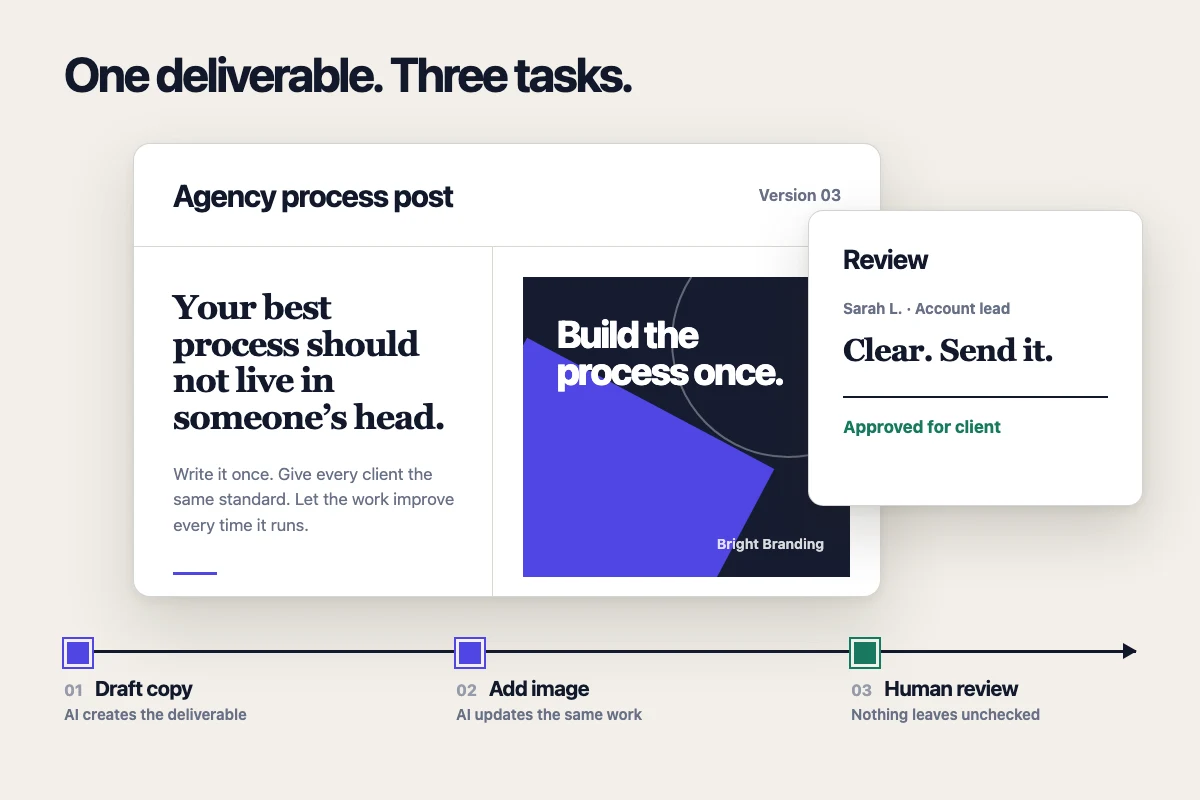
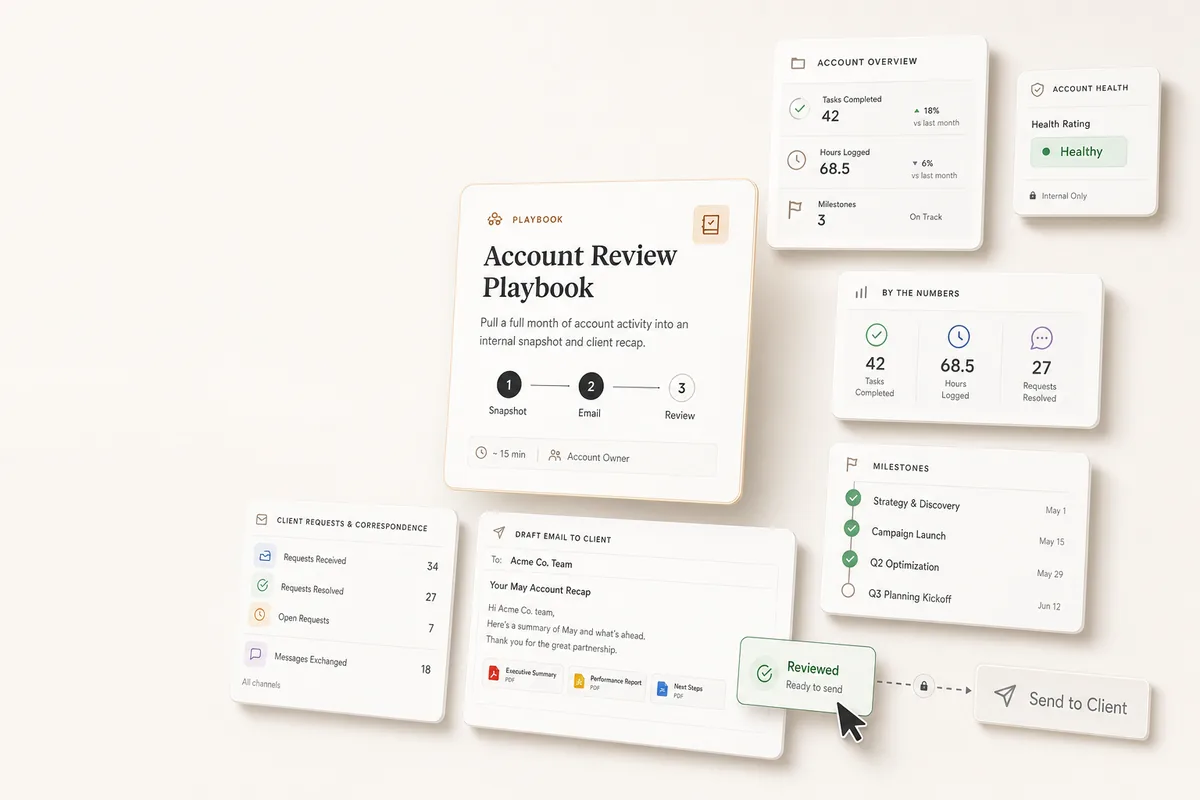
The daily habit: scan the Dashboard each morning for requests, milestones, and workload balance, or ask Lifty for a quick summary. The weekly habit: check Completed work and rebalance with Bulk Update if needed. The monthly habit: review hours per client, run your AI schedulers for next month, and preview each client’s portal. For hands-off monthly work, check out the AI Playbooks, pre-built task chains for reporting, SEO audits, content creation, and more.
The more consistently you use these screens, the less time you spend chasing updates and the more time you have for the actual work.